
Telehealth Play Therapy Techniques
Training
Oct. 16th, 9am-12pm
With Kathryn Klock-Powell, PhD, LMFT, RPT-S
Session Cost
$90
Have you given up on providing play therapy online? Since 2020 more therapists are providing therapy via telehealth – but many providers draw the line at engaging with children at a distance. We believe that the reluctance to provide play therapy via telehealth is due to a lack of confidence, lack of skills and interventions that are doable online.
This workshop will cover best practices for engaging with children via telehealth, but also provide the opportunity to experience play therapy interventions while online. We will have breakout discussions regarding clinical challenges and experiences providing play therapy post-COVID. We will also present a toolbox of ideas for working with children online that will help make therapy more fun and playful for both our clients and for us as therapists!
Objectives
- Participants shall understand the ethical standards that are unique to providing play therapy services online.
- Participants will be able to identify several ideas to keep play therapy interactive and experiential even when at a distance.
- Participants will be able to describe clinical best practices when providing play therapy via telehealth.
APT approved provider 21-636
3 Contact hours (in person)
3 Non-Contact hours (virtual)
Do No Digital Harm:
Ethical AI in Mental Health Practice
Training
Nov. 13th, 9am-12pm
With Ashley Moore MS, LMFT, AAMFT Approved Supervisor
Session Cost
$90
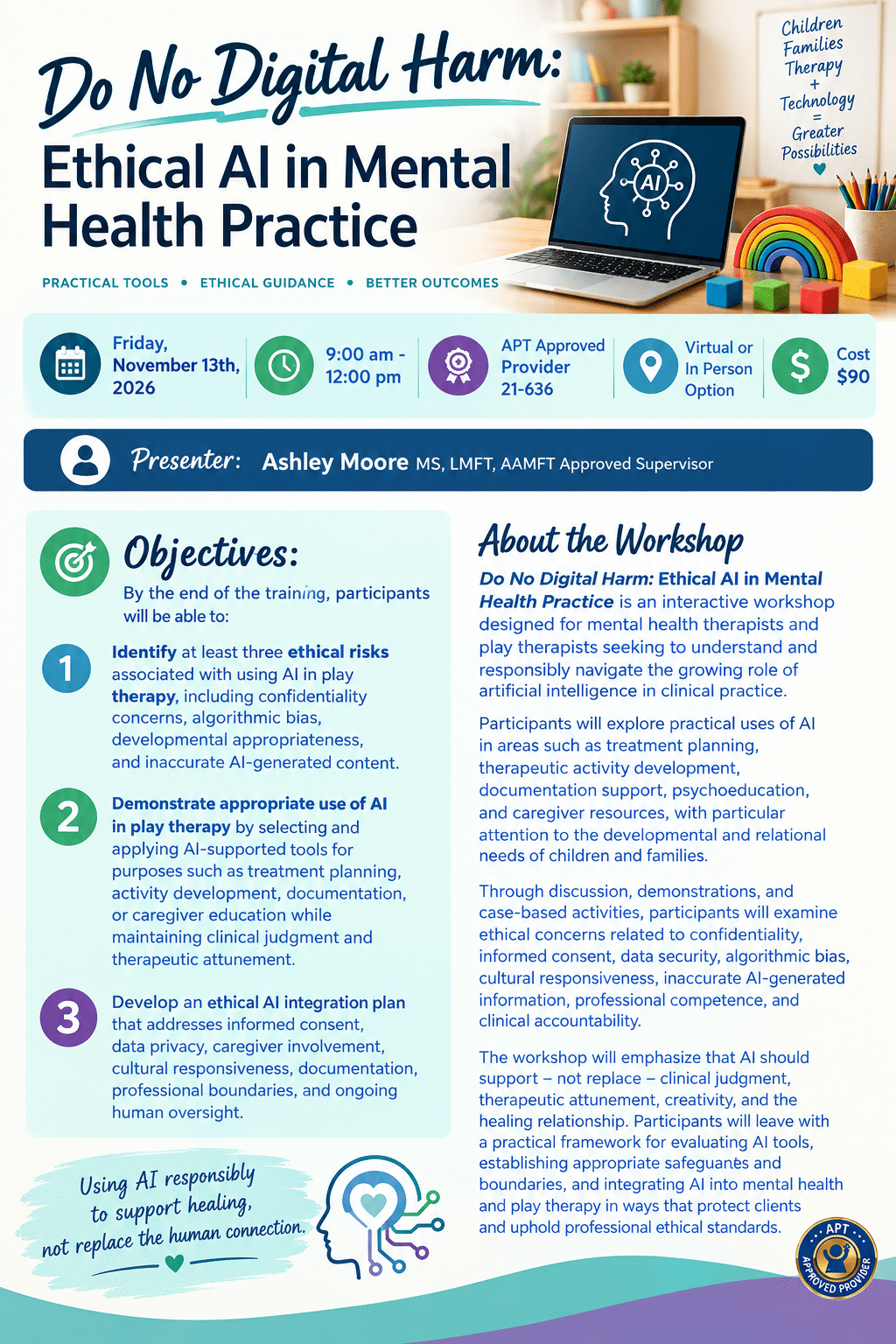
Do No Digital Harm: Ethical AI in Mental Health Practice is an interactive workshop designed for mental health therapists and play therapists seeking to understand and responsibly navigate the growing role of artificial intelligence in clinical practice.
Participants will explore practical uses of AI in areas such as treatment planning, therapeutic activity development, documentation support, psychoeducation, and caregiver resources, with particular attention to the developmental and relational needs of children and families.
Through discussion, demonstrations, and case-based activities, participants will examine ethical concerns related to confidentiality, informed consent, data security, algorithmic bias, cultural responsiveness, inaccurate AI-generated information, professional competence, and clinical accountability.
The workshop will emphasize that AI should support – not replace – clinical judgment, therapeutic attunement, creativity, and the healing relationship. Participants will leave with a practical framework for evaluating AI tools, establishing appropriate safeguards and boundaries, and integrating AI into mental health and play therapy in ways that protect clients and uphold professional ethical standards.
Objectives
- Identify at least three ethical risks associated with using AI in play therapy, including confidentiality concerns, algorithmic bias, developmental appropriateness, and inaccurate AI-generated content.
- Demonstrate appropriate use of AI in play therapy by selecting and applying AI-supported tools for purposes such as treatment planning, activity development, documentation, or caregiver education while maintaining clinical judgment and therapeutic attunement.
- Develop an ethical AI integration plan that addresses informed consent, data privacy, caregiver involvement, cultural responsiveness, documentation, professional boundaries, and ongoing human oversight.
APT approved provider 21-636
3 Contact hours (in person)
3 Non-Contact hours (virtual)
The Story Beneath the Sand:
Understanding the Client’s World Through Sandtray
Training December 4th
With Sherri Christopher, MA, LMFT
Location: Pooler office
Session Cost
- Morning Session 9a-12p (Virtual Only)
- 3 CEs
- Cost: $180
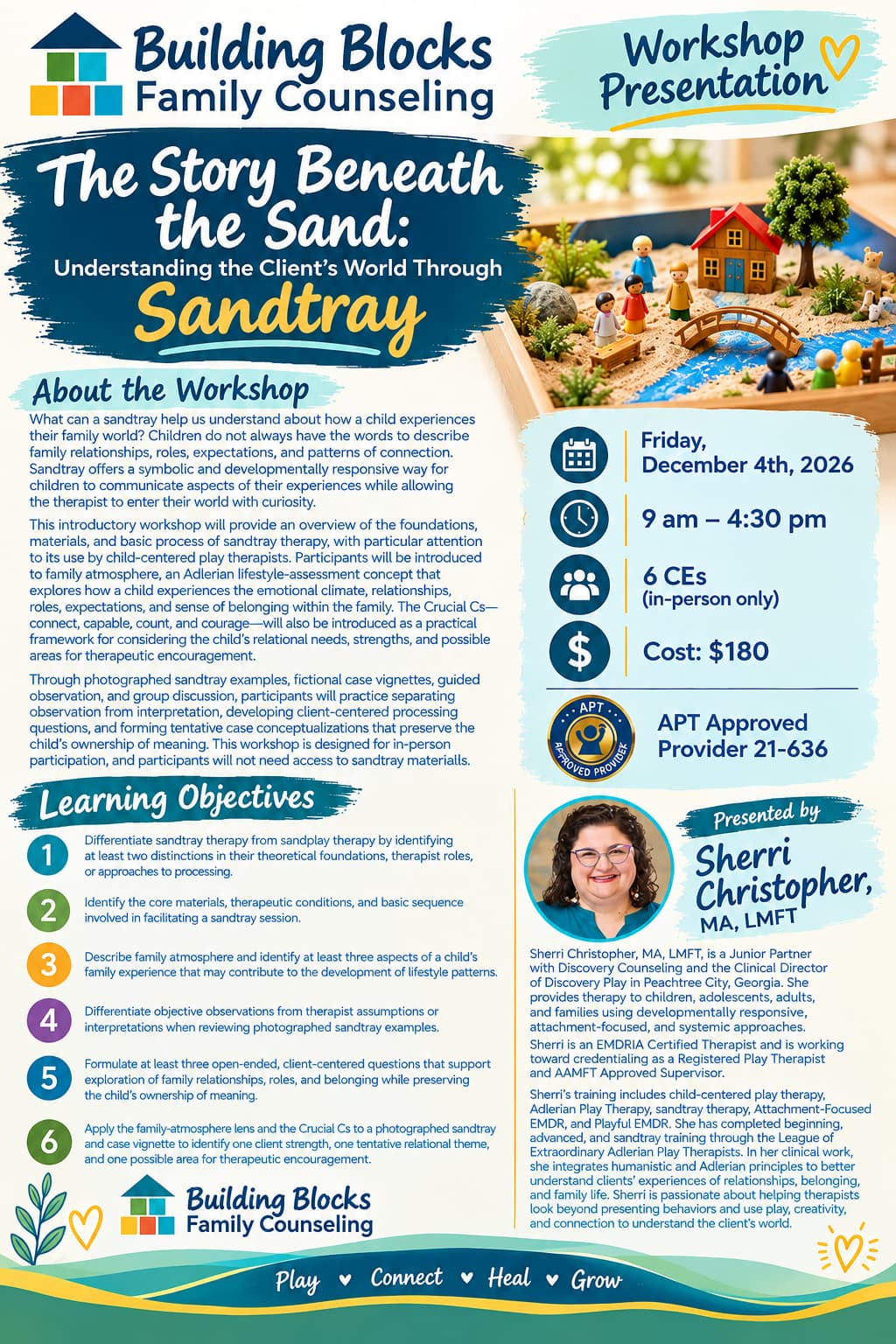
What can a sandtray help us understand about how a child experiences their family world? Children do not always have the words to describe family relationships, roles, expectations, and patterns of connection. Sandtray offers a symbolic and developmentally responsive way for children to communicate aspects of their experiences while allowing the therapist to enter their world with curiosity.
This introductory workshop will provide an overview of the foundations, materials, and basic process of sandtray therapy, with particular attention to its use by child-centered play therapists. Participants will be introduced to family atmosphere, an Adlerian lifestyle-assessment concept that explores how a child experiences the emotional climate, relationships, roles, expectations, and sense of belonging within the family. The Crucial Cs—connect, capable, count, and courage—will also be introduced as a practical framework for considering the child’s relational needs, strengths, and possible areas for therapeutic encouragement.
Through photographed sandtray examples, fictional case vignettes, guided observation, and group discussion, participants will practice separating observation from interpretation, developing client-centered processing questions, and forming tentative case conceptualizations that preserve the child’s ownership of meaning. This hybrid workshop is designed for both in-person and virtual participation, and participants will not need access to sandtray materials.
Objectives
- Differentiate sandtray therapy from sandplay therapy by identifying at least two distinctions in their theoretical foundations, therapist roles, or approaches to processing.
- Identify the core materials, therapeutic conditions, and basic sequence involved in facilitating a sandtray session.
- Describe family atmosphere and identify at least three aspects of a child’s family experience that may contribute to the development of lifestyle patterns.
- Differentiate objective observations from therapist assumptions or interpretations when reviewing photographed sandtray examples.
- Formulate at least three open-ended, client-centered questions that support exploration of family relationships, roles, and belonging while preserving the child’s ownership of meaning.
- Apply the family-atmosphere lens and the Crucial Cs to a photographed sandtray and case vignette to identify one client strength, one tentative relational theme, and one image.jpegpossible area for therapeutic encouragement.
APT approved provider 21-636
6 Contact hours (in person)